
Harvest Fuel Care: How to Prevent Diesel Bug & Water Contamination in Farm Tanks
Harvest is one of the busiest times of year on an Irish farm. Tractors are working long hours, combines and loaders are being pushed hard, and every machine needs to start and keep running when the weather finally gives you a window.
The last thing you need is a blocked fuel filter, contaminated diesel or a tractor that suddenly loses power in the middle of a field.
One of the most common causes is poor fuel quality caused by water contamination and diesel bug.
The good news is that most fuel contamination problems are preventable. With a few straightforward checks, the right filtration and sensible tank maintenance, farmers can significantly reduce the risk of fuel-related breakdowns during harvest.
This guide explains practical diesel bug prevention for farm tanks, how to deal with water in farm diesel tanks, what signs to look for in agricultural machinery and how to keep marked gas oil in good condition throughout the year.
Why diesel tank maintenance matters during harvest
Fuel storage can often be overlooked during the busy months. If the tractor starts every morning, it is easy to assume the fuel tank is doing its job.
However, problems can build up inside a tank long before they become obvious.
A farm diesel tank is exposed to changing temperatures, rain, dust, moisture and regular filling and dispensing. If water gets into the tank, it can settle at the bottom beneath the diesel. That water creates an ideal environment for microbial growth.
Once diesel bug becomes established, it can produce sludge and slime that gets drawn into the fuel system.
The consequences can include:
- Blocked fuel filters
- Restricted fuel flow
- Poor engine performance
- Fuel starvation
- Injector problems
- Sludge and sediment in the tank
- Corrosion of tanks and pipework
- Increased maintenance and downtime
For a farmer or agricultural contractor, the real cost is not just the replacement filter or additive. It is the machine sitting idle when there is work to be done.
That is why agri fuel storage maintenance should form part of your normal pre-harvest preparation rather than something you only think about when a tractor develops a problem.
What causes diesel bug in farm fuel tanks?
Despite the name, diesel bug is not an insect. It is a general term used for microbial contamination of fuel.
Microorganisms can grow where fuel and water are present together. Water is therefore one of the biggest factors behind a diesel bug problem.
A tank containing a small amount of water at the bottom may appear perfectly normal from the outside. But over time, bacteria and fungi can multiply at the fuel-water interface and produce biomass, sludge and slime.
Several factors can increase the risk:
Water entering the tank
Rainwater can enter through poorly sealed or damaged fill points, caps, vents or access covers.
Condensation
A tank that is repeatedly exposed to temperature changes can develop condensation inside it. This is particularly relevant where tanks are only partially filled for long periods.
Long-term fuel storage
Fuel that sits unused for extended periods needs more attention than fuel that is regularly turned over.
Contaminated deliveries
If fuel is contaminated before it reaches your storage tank, the problem can be introduced directly into the tank.
Dirty equipment
Dust, dirt and moisture around the fill point or dispensing equipment can also contribute to contamination.
Good green diesel tank maintenance therefore starts with keeping water out in the first place.
How to get water out of a farm diesel tank?
If you suspect water in a farm diesel tank, don’t simply assume that a fuel filter will solve the problem.
The first step is to determine whether water is actually present at the bottom of the tank.
Because water is heavier than diesel, it generally settles beneath the fuel. Depending on the tank design, this can sometimes be checked by drawing a sample from the lowest point or using an appropriate water-detection method.
If water is present, it needs to be removed safely rather than simply allowing the dispensing system to draw it into the tractor.
For larger or contaminated tanks, professional tank cleaning may be appropriate, particularly if there is visible sludge or evidence of an established diesel bug infestation.
Do not dispose of contaminated diesel, water or sludge down drains, onto soil or into watercourses. Diesel is an environmental contaminant, and Irish farm guidance recommends that diesel and oils are stored in suitable bunded arrangements.
If water or particulate contamination is a concern, a water-absorbent diesel tank filter can help remove unwanted water and particles while fuel is being transferred.
Practical tip: Check the bottom of your tank before harvest rather than waiting until a tractor starts showing symptoms.
What are the signs of diesel bug in agricultural equipment?
The symptoms of diesel bug can sometimes look like an ordinary fuel-system fault.
That is why it is worth checking the fuel itself if several machines begin experiencing similar problems.
Common warning signs include:
- Black or brown slime around filters
- Repeatedly blocked fuel filters
- Sludge in the tank
- Poor fuel flow
- Engine hesitation or loss of power
- Difficult starting
- Unexpected fuel starvation
- Increased frequency of filter replacement
- Corrosion around parts of the fuel system
One particularly useful clue is tractor fuel filter clogging with black slime.
If you replace a filter and find a sticky, dark or slimy material rather than ordinary dirt and sediment, don’t simply fit another filter and carry on. Investigate the fuel tank and fuel supply.
Otherwise, the replacement filter may become blocked again.
Rotech’s existing fuel guidance identifies sludge, emulsions, restricted fuel flow and blocked filters as common consequences of microbial contamination.
How to stop condensation in farm fuel tanks during harvest?
You cannot completely eliminate condensation, but you can reduce the conditions that allow it to become a problem.
Temperature changes cause the air space inside a partially filled tank to expand and contract. Moisture in that air can contribute to condensation inside the tank.
During harvest, consider the following:
Keep the tank reasonably full
Where practical, avoid leaving a tank sitting partially empty for long periods, particularly over periods when fuel usage is low.
Keep fill points and caps clean
A damaged or poorly sealed fill point can allow rainwater and dirt into the fuel.
Check the breather
The tank needs to breathe, but the breather should be in good condition and protected from unnecessary exposure to water and contamination.
Protect the tank from unnecessary exposure
A suitable location and well-maintained tank can reduce exposure to the elements.
Check the tank after periods of heavy weather
If the tank has been exposed to significant rainfall, inspect the fill point, cap, seals and surrounding area for signs of water ingress.
These simple checks can make a significant difference to diesel bug prevention in farm tanks.
Is green diesel more prone to diesel bug?
Not simply because it is green diesel.
Marked Gas Oil (MGO), commonly called green diesel in Ireland, is widely used for agricultural machinery and other permitted non-road applications. The bigger issue for diesel bug is the presence of water, contamination, storage conditions and how long the fuel remains in storage.
However, modern diesel fuels and changes in fuel composition mean that fuel storage should not be treated in exactly the same way as it might have been years ago.
Rotech’s own fuel guidance notes that biofuel can encourage microbial growth by attracting water, making good storage practices particularly important.
The important point for farmers is that changing fuel type does not remove the need for proper tank maintenance.
Whether you are storing marked gas oil for tractors, diesel for commercial vehicles or another compatible fuel, clean and dry storage is the foundation of good fuel management.
Preventing diesel bug before it becomes a problem
Treating an established infestation is considerably more inconvenient than preventing one.
A good preventative routine should include four basic areas:
1. Keep water out
Check caps, fill points, vents and tank seals regularly.
2. Monitor the fuel
Look for signs of sludge, cloudiness, unusual odours or water when checking fuel samples.
3. Filter fuel when dispensing
A suitable fuel filter can remove particles and, with a water-absorbent element, help protect machinery from water contamination during dispensing.
4. Consider an appropriate fuel treatment
Where there is a known contamination risk or where fuel is being stored for extended periods, an appropriate diesel additive can form part of a wider fuel-management programme.
Best diesel additive to prevent water contamination in Ireland
There isn’t one additive that can compensate for poor tank maintenance.
The first priority should always be to prevent water entering the tank and to remove existing water where necessary.
For diesel bug specifically, however, a dedicated anti-microbial treatment can be useful.
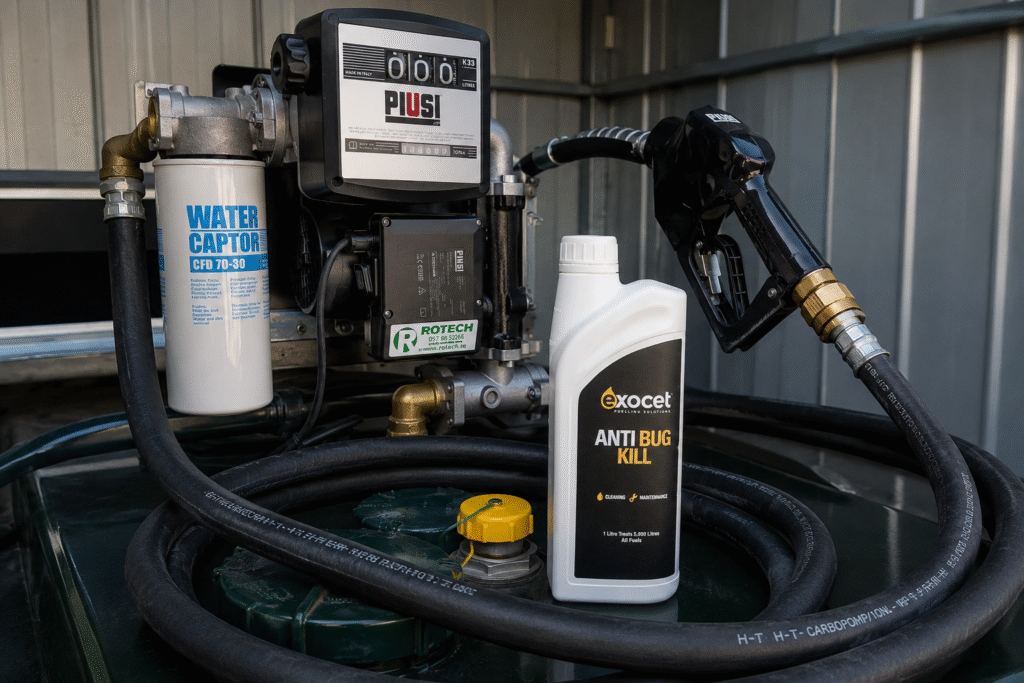
Rotech stocks Exocet Anti Bug Kill, which is designed to control and prevent microbial growth in diesel fuel. According to Rotech’s product information, one litre treats up to 5,000 litres of diesel.
It can be used as part of routine fuel maintenance or when dealing with an identified contamination problem.
The important distinction is that an anti-bug additive is not a substitute for removing water. If water remains in the tank, the underlying conditions for microbial growth can remain.
Think of the additive as part of a fuel-management system rather than a cure-all.
Using a water absorber and fuel filter to protect tractors
One of the simplest ways to improve fuel quality is to filter diesel as it moves from the storage tank into the machine.
A good filtration setup can remove particulate contamination while a water-absorbent filter helps deal with water present in the fuel.
For example, Rotech supplies PIUSI filtration systems incorporating both particle filtration and water-absorbent filtration. Its Cube 56 and Cube 70 filter kits combine a 10-micron particle filter with a water-absorbent filter.
This matters because the fuel leaving the storage tank is the fuel that ultimately reaches your tractor, telehandler, loader, truck or other equipment.
A water trap filter for a farm diesel tank can therefore act as an important final line of defence.
How often should you replace fuel storage tank filters?
There is no single replacement interval that suits every farm.
Filter life depends on:
- Fuel quality
- Tank cleanliness
- Fuel turnover
- Tank size
- Environmental conditions
- Amount of contamination being removed
- How much diesel is being dispensed
- Whether the tank has previously had a contamination problem
Rather than relying solely on a calendar date, inspect the filter regularly and watch for signs of restricted flow or visible contamination.
During a busy harvest period, it is particularly sensible to check the filter before the machinery gets into continuous operation.
If a filter becomes heavily contaminated, replace it and investigate why it became blocked. Repeated filter blockage is a warning that there may be a wider fuel contamination problem.
For farms with high fuel usage, contractors and commercial fleets, keeping spare filter elements on hand can also prevent an avoidable delay when a filter needs changing.
A practical pre-harvest fuel tank check
Before the first long days of harvest, take 15–30 minutes to work through your fuel system.
Farm diesel tank
- Check the tank for visible damage or corrosion.
- Inspect the fill cap and seals.
- Check the breather.
- Look for signs of water ingress.
- Check the bottom of the tank for water or sludge where appropriate.
- Inspect the dispensing hose and nozzle.
- Check the pump for leaks.
- Inspect fuel filters and replace contaminated elements.
- Check that water-absorbent filtration is functioning correctly.
- Check the bund and surrounding area for signs of leakage.
Tractor and machinery
- Check fuel filters before heavy seasonal use.
- Look for unusual deposits or slime.
- Investigate repeated fuel-flow problems.
- Don’t ignore difficult starting or unexplained power loss.
- Keep the fuel system clean when changing filters.
Fuel management
- Avoid unnecessary long-term storage.
- Keep records of fuel deliveries where useful.
- Treat fuel appropriately if there is an identified contamination risk.
- Keep the tank and dispensing equipment clean.
- Make sure contaminated fuel and waste are disposed of appropriately.
Marked gas oil storage best practices for Irish farms
Good marked gas oil storage best practices are about more than protecting the fuel.
A diesel leak can contaminate soil, drains and groundwater, making proper storage an important environmental and farm-safety issue.
Teagasc advises that farm diesel and oils should be stored in a bunded structure. The EPA also highlights the need to prevent fuel spills and leakages from contaminating wells and surrounding groundwater.
Your tank should therefore be located appropriately, kept in good condition and protected against accidental damage.
For farms with private wells in particular, fuel storage location and spill prevention deserve extra attention.
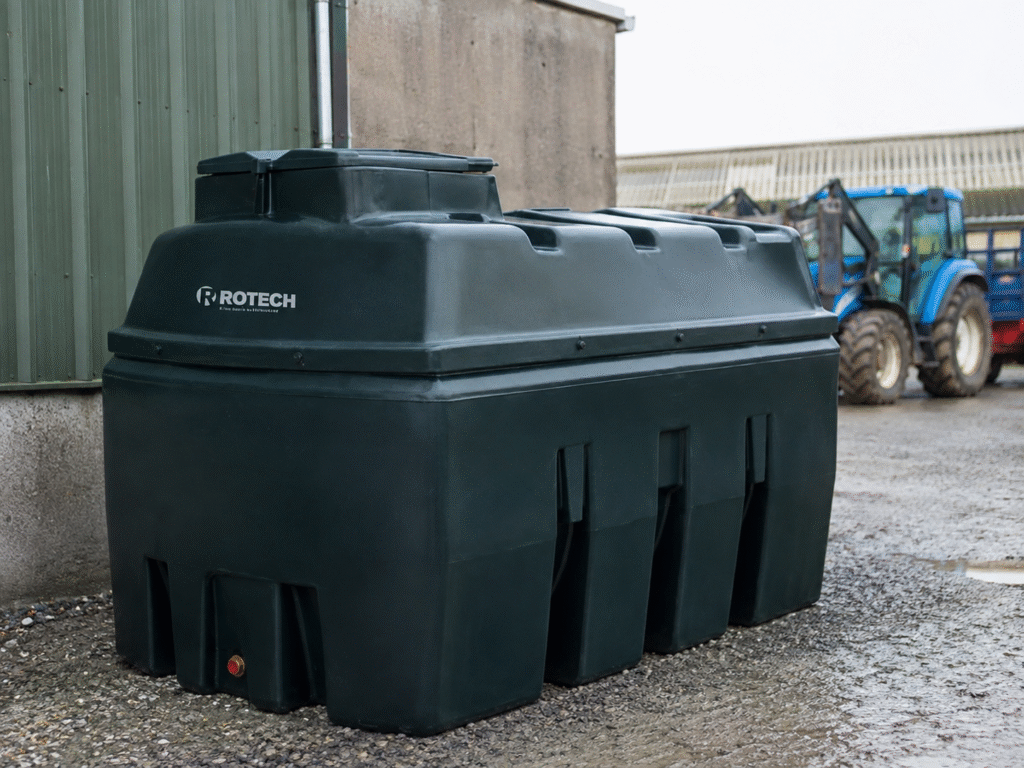
Rotech supplies fully bunded diesel storage solutions in a range of sizes, including tanks equipped with PIUSI pumps, meters and filtration.
Don’t wait for a tractor breakdown to check your fuel
Fuel contamination is one of those problems that is much easier to prevent than to deal with in the middle of harvest.
If a tractor is losing power, repeatedly blocking its fuel filter or struggling to start, don’t automatically assume the problem is the engine.
Check the fuel.
Water in the storage tank, microbial growth and contaminated diesel can all cause problems further down the fuel system.
A sensible maintenance routine is straightforward:
Keep water out → keep the tank clean → filter the fuel → monitor for contamination → treat when necessary.
For farms and agricultural contractors running multiple machines, this small amount of preventative maintenance can help reduce unexpected downtime when every working hour counts.
FAQ: Diesel Bug & Farm Fuel Storage
How to get water out of a farm diesel tank?
Water should be removed safely from the lowest point of the tank using a suitable method for the tank design. If there is significant water, sludge or microbial contamination, professional tank cleaning may be required. Do not dispose of contaminated water or diesel onto soil or into drains.
What are the signs of diesel bug in agricultural equipment?
Common signs include repeated fuel filter blockage, black or brown slime, sludge, restricted fuel flow, difficult starting, loss of engine power and fuel starvation. If a replacement filter quickly becomes blocked again, investigate the storage tank rather than repeatedly replacing filters.
How to stop condensation in farm fuel tanks during harvest?
Reduce the amount of time fuel is stored in a partially empty tank, keep fill points and caps properly sealed, maintain the tank breather and inspect the tank regularly for water ingress. Good tank maintenance and water removal are key.
Is green diesel more prone to diesel bug?
Green diesel itself is not automatically more prone to diesel bug. Microbial growth is strongly associated with the presence of water and suitable storage conditions. Good tank hygiene, water control and appropriate fuel treatment can reduce the risk.
Best diesel additive to prevent water contamination in Ireland
An anti-bug diesel additive can help control microbial growth, but it should not be considered a replacement for removing water from the tank. Rotech stocks Exocet Anti Bug Kill for diesel bug prevention and treatment, alongside other Exocet fuel additives.
How often should you replace fuel storage tank filters?
There is no universal replacement interval. Check filters regularly and replace them when they become contaminated, restricted or when the manufacturer’s guidance requires it. High-use farms and contractors should check filtration more frequently during periods such as harvest.
Keep your fuel ready for the busiest days of the year
Your diesel tank is effectively part of your farm’s machinery infrastructure. If the fuel going into the tractor is contaminated, even the newest and best-maintained machine can suffer.
Before harvest gets into full swing, check your tank, remove any water, inspect your filters and deal with signs of contamination before they become a breakdown.
RotechShop.ie supplies diesel tanks , pumps , filters and fuel additives for farms, agricultural machinery, commercial vehicles and other fuel-handling applications across Ireland.
If you’re unsure which filter, pump or fuel treatment is right for your setup, speak to Rotech about your tank size, fuel usage and machinery requirements before choosing a solution.