
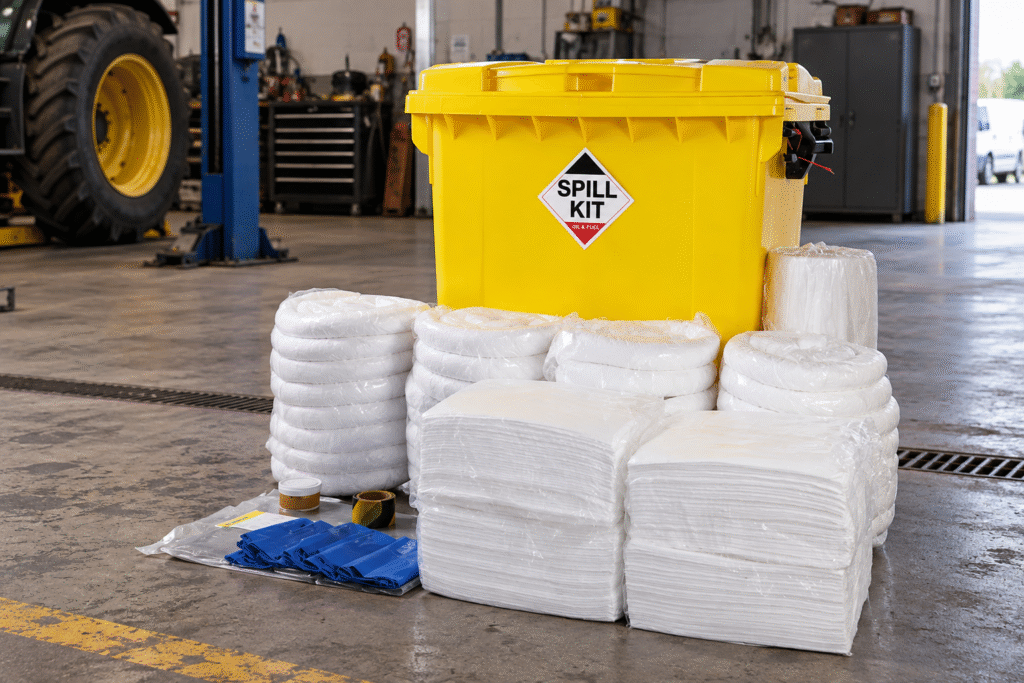
A leaking oil drum, a split hydraulic hose or an overturned chemical container can turn an ordinary working day into a costly and potentially dangerous incident. In a busy workshop or vehicle depot, liquids can spread across floors, create slip hazards, damage equipment and, if they reach drains or soil, cause serious environmental problems.
For depot managers responsible for tractors, HGVs, vans, plant machinery or commercial maintenance operations, spill prevention should be part of everyday site management—not something considered only after an accident.
But what equipment do you actually need? How much secondary containment is enough? Does every workshop need a spill kit? And does the often-mentioned 110% containment rule apply to your storage setup?
This guide explains the key HSA spill containment requirements for workshops in Ireland, the practical role of spill kits, bunded pallets, drip trays and IBC containment, and how to build a sensible spill-response system for your depot.
Important: This article provides practical guidance, not a legal determination of compliance. The correct containment arrangements depend on the substances stored, their quantities, how they are handled, the site risk assessment and any specific statutory or environmental requirements that apply.
What are the HSA spill containment requirements for workshops in Ireland?
The Health and Safety Authority (HSA) expects employers to manage workplace hazards through suitable risk assessments and appropriate control measures. Spills are particularly relevant to workshops and depots because they can create slip and trip risks, expose workers to hazardous substances and interfere with normal operations.
The HSA’s guidance on preventing slips, trips and falls recommends a practical approach to spills:
Identify the risk.
Prevent the spill where possible.
Contain the liquid.
Detect and assess the incident.
Cordon off the affected area.
Remove the spill safely.
The HSA also recommends considering suitable storage arrangements for liquids, maintaining equipment and pipework, and using appropriate containment to reduce the likelihood and spread of spills.
For a workshop manager, this means compliance is not simply a matter of purchasing a spill kit and leaving it in the office. You need to consider the actual risks in your workplace.
What should a workshop risk assessment consider?
A practical assessment should examine:
What liquids are stored or used on site?
Are they hazardous, flammable, corrosive or environmentally harmful?
How much is stored in drums, jerry cans, IBCs or tanks?
Where are liquids transferred, decanted or dispensed?
Could a leaking container be struck by a forklift, telehandler or vehicle?
Are containers stored close to walkways, vehicle routes or drains?
What happens if a hose, valve, drum or IBC fails?
Is there a suitable spill kit close to the risk?
Do staff know how to respond to a leak or spill?
How will contaminated absorbents and waste be collected and disposed of?
The HSA’s warehouse guidance specifically highlights secondary containment, spill kits, safe storage and emergency response arrangements as important controls when hazardous chemicals are stored.
Workshop spill kit requirement Ireland: What equipment should you have?
There is no single universal spill kit that suits every Irish workshop. The right kit depends on the liquids present, the likely size of a spill and the response procedure established by the business.
A small agricultural repair workshop may need a portable oil spill kit for hydraulic oil and diesel leaks. A large fleet depot may need several kits positioned around maintenance bays, fuel-handling areas, chemical stores and vehicle parking areas.
The key is to ensure that staff can access the right equipment quickly.
What should an oil spill response kit contain?
A practical kit for common workshop oil and fuel spills may include:
Oil-absorbent pads for soaking up liquid on floors and around machinery.
Absorbent socks to surround a spill and stop it spreading.
Absorbent booms for larger spills or areas where liquid could reach drains.
Suitable disposal bags and ties for contaminated absorbents.
Protective gloves and other appropriate PPE.
Clear instructions for responding to the type of spill involved.
For larger sites, it can also be useful to have a dedicated spill-response station with additional absorbents and equipment for dealing with a more substantial incident.
Important: Oil-only absorbents are not necessarily suitable for every chemical. If your workshop handles acids, solvents, cleaning chemicals or other hazardous substances, select equipment compatible with those materials and follow the relevant Safety Data Sheet (SDS).
Where should spill kits be located?
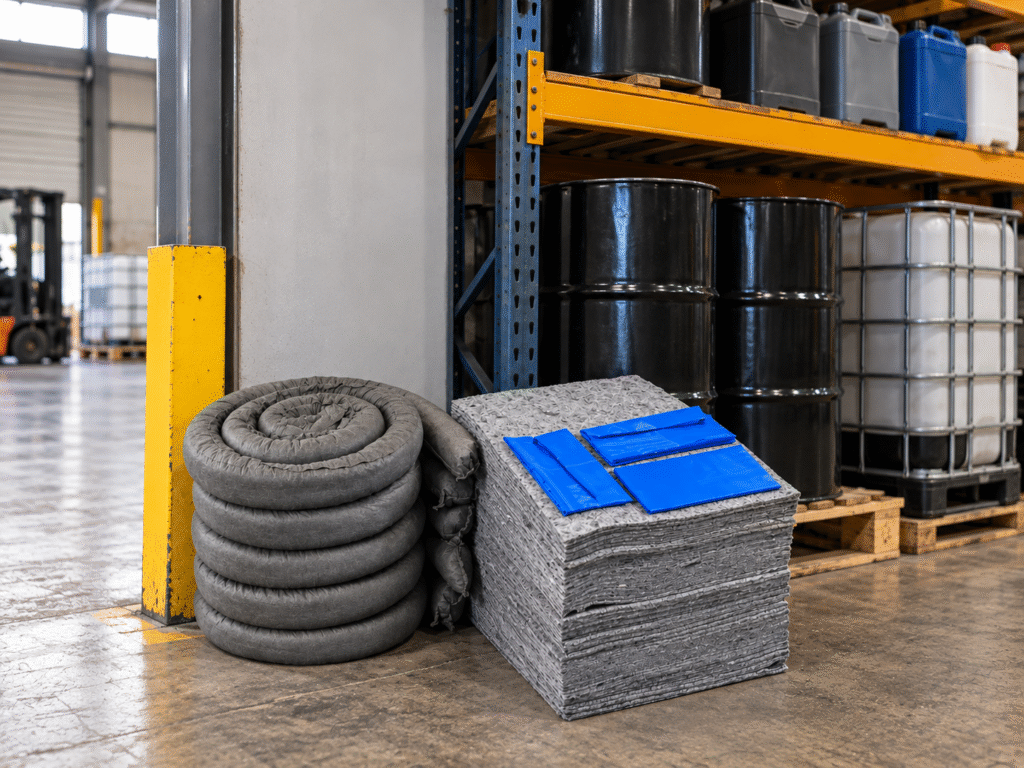
A spill kit should be easy to find and accessible without staff having to cross a contaminated area.
Consider positioning kits near:
Vehicle maintenance bays.
Oil and lubricant storage.
Diesel dispensing points.
Chemical storage areas.
Workshop entrances and exits.
Fuel and fluid transfer areas.
Loading and unloading zones.
Mobile plant maintenance areas.
A depot with several buildings or large outdoor operating areas may need multiple kits rather than one central kit.
RotechShop.ie supplies portable spill kits designed for oil, diesel, hydraulic oil and other non-hazardous liquid spills, as well as dedicated chemical spill kits for suitable applications.
What is secondary containment and why does it matter?
Secondary containment is a system designed to capture liquid if the primary container leaks, ruptures or spills.
The primary container might be:
A 200-litre oil drum.
An IBC.
A chemical container.
A diesel storage tank.
A smaller lubricant or AdBlue container.
The secondary containment system could be a bunded pallet, bunded tank, spill tray, drip tray or suitably designed impermeable bunded area.
The purpose is to prevent a leak from spreading into the workshop, reaching drains or contaminating surrounding ground.
For depot managers, secondary containment is particularly valuable where liquids are stored in areas exposed to vehicle movements, forklift traffic or frequent handling.
Bunded pallet regulations Ireland: What do you need to know?
Bunded pallets are widely used in Irish workshops, garages, warehouses and industrial depots to store drums and IBCs safely.
However, it is important to distinguish between a suitable containment design and a blanket statutory requirement.
The correct bund capacity and construction depend on the liquid, the volume stored, the location, the storage arrangements and the relevant regulatory or environmental requirements. A business should not assume that purchasing any bunded pallet automatically makes its storage compliant.
The HSA recommends considering secondary containment such as bunded pallets or individual container bunded trays where appropriate.
Before selecting a bund, check:
The total volume and number of containers.
The liquid’s chemical compatibility with the bund material.
The required containment capacity.
Whether the bund is suitable for indoor or outdoor use.
Whether forklift access is needed.
Whether the design allows inspection and cleaning.
Whether the storage area needs protection from vehicle impact.
Whether additional environmental or fire-safety measures apply.
What is the 110% secondary containment rule HSA?
The phrase “110% secondary containment rule” is often used when discussing fuel, oil and chemical storage.
It generally refers to a containment capacity of at least 110% of the largest container, or another applicable capacity requirement, depending on the particular storage arrangement and regulatory guidance.
However, 110% is not a universal HSA rule for every workshop container or spill pallet.
For example, an environmental storage specification may require containment based on the largest container or a proportion of the total stored volume. Some oil storage arrangements may be subject to specific requirements, while other situations may require a different assessment.
The EPA has published environmental guidance that uses a 110% of the largest container or 25% of total container volume approach for certain hazardous-substance storage situations, with the greater capacity applying. That guidance should not automatically be treated as the legal requirement for every depot.
Practical advice: Do not select a bund solely because it is advertised as “110% compliant”. Confirm the capacity and design requirements for your particular storage arrangement, substance and site.
IBC spill pallet compliance: Choosing the right containment
Intermediate Bulk Containers (IBCs) are common in transport depots, agricultural businesses, workshops and industrial operations.
They may be used to store:
Hydraulic oil.
Lubricants.
AdBlue.
Diesel-related fluids.
Cleaning products.
Industrial chemicals.
An IBC can hold a substantial quantity of liquid, so a damaged valve, cracked container or impact from a forklift can result in a significant spill.
An IBC spill pallet provides a dedicated base with a raised containment sump beneath the container. This gives the liquid somewhere to collect if the IBC leaks, rather than allowing it to spread across the floor.
What should you check before buying an IBC spill pallet?
For IBC spill pallet compliance, consider:
Sump capacity: Is the containment volume sufficient for your storage arrangement and applicable requirements?
Material compatibility: Is the pallet suitable for the chemical, oil, fuel or AdBlue being stored?
Load capacity: Can it safely support the full IBC and its contents?
Forklift access: Can the pallet be loaded and moved safely?
Inspection access: Can the sump and container be checked for leaks?
Drainage: Does the design prevent the contents from escaping, and how will any collected liquid be removed?
Site conditions: Is the pallet suitable for indoor or outdoor use?
Container condition: Is the IBC itself in good condition and appropriate for the liquid?
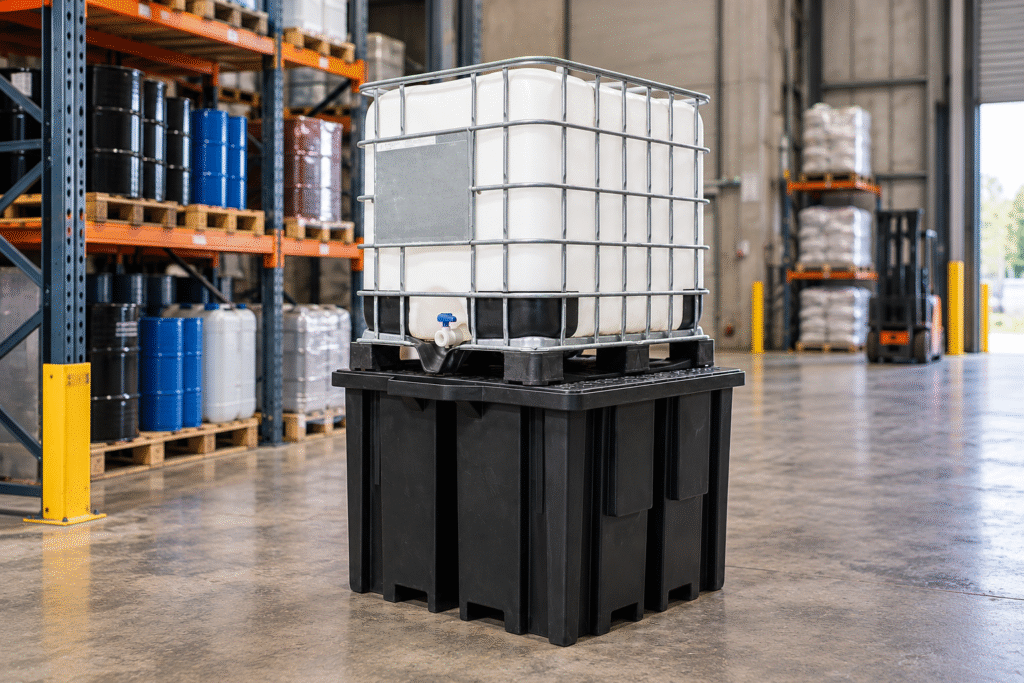
RotechShop.ie supplies IBC bunds and spill pallets in steel and polyethylene, including options for storing one or multiple IBCs. The range is intended for practical containment of liquids such as oil, fuel, AdBlue and chemicals, subject to suitability for the particular substance.
Drip tray capacity regulations Ireland: How much containment do you need?
Drip trays are useful for capturing smaller leaks and spills from equipment, containers, machinery and fluid-handling points.
They are commonly used beneath:
Oil drums.
Hydraulic equipment.
Small chemical containers.
Diesel dispensing equipment.
Generators.
Pumps and hoses.
Vehicle maintenance components.
IBC taps and connections.
A drip tray is not automatically a substitute for a bunded storage system. Its capacity must be suitable for the risk it is intended to control.
How do you choose the right drip tray capacity?
When considering drip tray capacity regulations in Ireland, start with the actual application.
Ask yourself:
What is the largest container or component that could leak?
Is the tray intended to catch occasional drips or a significant release?
Could rainwater collect in the tray?
Is the liquid compatible with the tray material?
Can the tray be emptied and cleaned safely?
Will a vehicle, machine or heavy object be placed on it?
Is the tray being used as primary protection or as part of a wider containment system?
For example, a small tray beneath a hydraulic coupling may be suitable for catching routine drips, while an IBC storage area requires a much more substantial containment arrangement.
RotechShop.ie offers low-profile spill trays, deep spill trays and flexible Spill Tector containment trays for different workshop and industrial applications.
Do drip trays need to be emptied?
Yes, any collected liquid should be managed promptly and safely.
A tray that is already full cannot provide effective additional containment. Collected oil, fuel, chemical residue or contaminated water must be assessed and disposed of in accordance with the appropriate waste-management requirements.
Outdoor containment systems also need attention after rainfall, as accumulated water can reduce available capacity.
Chemical spill kit for garage depot: Oil kits are not enough for every liquid
A garage or depot may handle a wide variety of liquids, from engine oil and diesel to brake cleaner, coolant, degreasers and specialist workshop chemicals.
Not all spills should be handled with the same absorbent material.
An oil-only spill kit is designed for suitable oil-based liquids and may not be appropriate for corrosive or reactive chemicals.
How to choose a chemical spill kit
For a chemical spill kit for a garage or depot, identify the substances stored on site and review their Safety Data Sheets.
Look for information about:
The substance’s hazards.
Appropriate absorbent materials.
Required PPE.
Incompatibilities.
Safe containment and disposal.
First-aid and emergency response measures.
Whether the substance reacts with water or particular materials.
For example, a workshop that stores acids, cleaning chemicals or other hazardous substances may require a dedicated chemical spill kit rather than a general oil spill kit.
RotechShop.ie supplies a 30-litre chemical spill kit containing absorbent pads, socks, disposal bags and ties in a portable carry bag. It is intended for suitable chemical spill-response applications and should be selected with reference to the substances present on site.
Should every depot have a chemical spill kit?
Not necessarily the same type or size of kit.
The correct approach is to assess the chemicals in use, the likely spill scenarios and the response procedures required. A depot storing only lubricating oils may have different needs from a workshop handling a range of corrosive or hazardous chemicals.
The important thing is that the equipment matches the risk and that staff know how to use it.
Industrial spill containment equipment Ireland: What should a depot manager consider?
A modern fleet depot or agricultural machinery workshop often needs more than a basic spill kit.
It may require a combination of containment, storage and response equipment to protect staff, equipment and the surrounding environment.
1. Bunded storage for drums and IBCs
Use suitable bunded pallets or IBC bunds where liquids are stored in containers that could leak or be damaged.
2. Spill trays beneath equipment
Use drip trays and containment trays where pumps, generators, machinery or fluid-handling equipment may produce leaks or drips.
3. Spill kits near high-risk areas
Make sure absorbent materials are readily available near fuel storage, maintenance bays, chemical stores and transfer points.
4. Suitable fuel and fluid storage tanks
Where diesel or other fluids are stored in bulk, consider purpose-designed tanks with appropriate containment, equipment and site arrangements.
5. Emergency response equipment
Ensure staff have access to suitable PPE, absorbents, disposal materials and clear procedures for dealing with spills.
6. Inspection and maintenance
Inspect tanks, bunds, pallets, hoses, valves and containers regularly. A containment system must remain in good condition to work when it is needed.
RotechShop.ie supplies industrial spill containment equipment including spill kits, bunded pallets, IBC bunds, drip trays and other fluid-handling products for workshops, farms, commercial vehicles and industrial operations.
How to create a practical spill-response plan for your depot
A spill kit is only effective if people know where it is and what to do with it.
A simple spill-response procedure can make a major difference during a leak or accidental release.
Step 1: Stop the source if it is safe
If a hose, valve or container is leaking, stop the transfer or isolate the source where this can be done safely.
Do not put yourself at risk trying to stop a spill.
Step 2: Protect people
Keep staff away from the affected area where there is a risk of slipping, exposure to hazardous substances, fire or harmful vapours.
Use suitable PPE and follow the relevant Safety Data Sheet.
Step 3: Prevent the spill from spreading
Use suitable absorbent socks, booms, pads or other compatible containment equipment to stop the liquid spreading.
Pay particular attention to drains, doorways and vehicle traffic routes.
Step 4: Contain and recover the liquid
Use appropriate equipment to absorb, collect or otherwise manage the spill in line with the substance-specific response procedure.
Step 5: Dispose of contaminated materials correctly
Contaminated absorbents, sludge and recovered liquid must be managed as appropriate for the substance and waste classification.
Do not wash oil or chemical spills into drains or onto the ground.
Step 6: Record and review the incident
Investigate what caused the spill, whether the existing containment was sufficient and whether staff need additional training or equipment.
A spill is not just an incident to clean up. It is an opportunity to identify a weakness in storage, maintenance or operating procedures.
Workshop spill containment checklist for depot managers
Use this checklist during a routine workshop inspection or before a busy maintenance period.
All oils, fuels and chemicals are identified.
Storage areas are included in the site risk assessment.
Containers are labelled and in good condition.
Suitable secondary containment is provided where required.
Bunds and spill pallets have sufficient capacity for their intended use.
Storage areas are protected from vehicle and forklift impact.
Spill kits are accessible and clearly identified.
Absorbents are compatible with the liquids stored.
Spill kits are fully stocked and not damaged.
Staff know the spill-response procedure.
Safety Data Sheets are available where required.
Drip trays and bunds are inspected and emptied safely.
Contaminated waste is handled appropriately.
Hoses, pumps, valves and fittings are checked for leaks.
Drainage routes and nearby environmental receptors have been considered.
Spill incidents are recorded and corrective actions reviewed.
Final thoughts: Make spill prevention part of everyday depot management
Good spill containment is about more than meeting a checklist. It protects your workforce, keeps the workshop operational, reduces environmental risks and helps prevent a minor leak from becoming a major incident.
For an Irish farm workshop, agricultural contractor, HGV depot or commercial fleet, the most effective approach is to combine:
Risk assessment + suitable storage + secondary containment + accessible spill kits + trained staff + regular inspections.
There is no one-size-fits-all solution. The correct equipment depends on the liquids you handle, the quantities stored and the conditions in which your business operates.
RotechShop.ie supplies a range of spill kits, spill containment trays, bunded pallets, IBC bunds and fluid-handling equipment for Irish agricultural, commercial and industrial customers.
Whether you are reviewing an existing workshop setup or preparing a new depot, Rotech can help you identify suitable containment and fluid-handling equipment for your application.
Explore RotechShop.ie’s spill containment and spill-response equipment to help keep your workshop safer, cleaner and better prepared.